
Do garment labels provide information about the elasticity of a garment?
As a supplier of garment labels, I've often pondered the role these small tags play in communicating crucial information to consumers. One such piece of information that can significantly impact the wearing experience is the elasticity of a garment. In this blog, I'll explore whether garment labels effectively provide details about a garment's elasticity and why it matters.
The Importance of Elasticity Information
Elasticity is a vital characteristic of clothing. It determines how well a garment fits, stretches, and recovers its shape. For consumers, knowing the elasticity of a garment can help them make informed purchasing decisions. For instance, in sportswear, high elasticity is often desired to allow for a full range of motion during physical activities. In contrast, formal wear may require less stretch to maintain a crisp and tailored look.
If a consumer is looking for a pair of yoga pants, they would likely want to know the degree of stretch to ensure they can move freely without the pants feeling too tight or restrictive. On the other hand, someone buying a suit jacket might prefer a fabric with minimal stretch to preserve its structured appearance.
Current State of Elasticity Information on Garment Labels
In my experience as a garment label supplier, I've noticed that while many labels provide information about fabric composition, care instructions, and sizing, details about elasticity are often lacking. Some labels may include a general statement like "stretchy fabric" or "contains elastic," but this is far from comprehensive.
For example, a label might indicate that a pair of jeans contains 5% elastane, which gives a rough idea of the potential stretch. However, this doesn't tell the consumer how much the fabric can stretch, how quickly it will recover its shape, or if the stretch is uniform in all directions.
Challenges in Providing Elasticity Information
There are several reasons why garment labels may not provide detailed elasticity information. Firstly, measuring and standardizing elasticity can be complex. Different fabrics have different stretch properties, and there is no one - size - fits - all method for quantifying elasticity. For example, a knitted fabric may stretch more in one direction than another, and the stretch may vary depending on the tension applied.
Secondly, there is a lack of industry standards for reporting elasticity on labels. Unlike sizing, which has relatively well - defined standards in many countries, there is no universal way to communicate elasticity to consumers. This makes it difficult for manufacturers to provide consistent and accurate information.
The Role of Garment Labels in Communicating Elasticity
Despite the challenges, garment labels can play a significant role in providing elasticity information. Labels can use visual cues, such as stretch icons, to give consumers a quick understanding of the fabric's stretchability. For example, a label could feature an icon showing how far the fabric can stretch horizontally and vertically.
Another approach is to provide numerical data. For instance, a label could state the percentage of stretch in different directions (e.g., 20% stretch horizontally and 30% stretch vertically) and the recovery rate (e.g., 90% recovery after stretching). This type of information can be more precise and help consumers make more informed decisions.
Our Solutions as a Garment Label Supplier
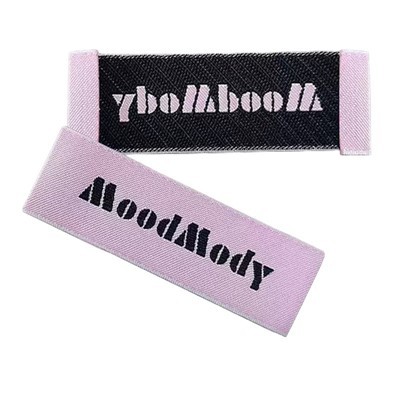
As a supplier of Woven Printed Garment Labels, we understand the importance of providing accurate and useful information on labels. We offer customizable label options that can include detailed elasticity information.
Our Manhattan Fold Woven Label is a popular choice for brands looking to convey multiple types of information, including elasticity. It has a large surface area that can accommodate detailed text and graphics.


For more specialized needs, our Woven Loop Label can also be customized to display elasticity details. The loop design allows for easy attachment to the garment and provides a unique way to present information.
Encouraging Consumer Confidence
By providing clear and accurate elasticity information on garment labels, we can help build consumer confidence. When consumers know what to expect in terms of stretch and recovery, they are more likely to be satisfied with their purchase. This can lead to increased brand loyalty and positive word - of - mouth.
For example, if a consumer buys a pair of leggings with a label that clearly states the stretch and recovery properties, and the leggings perform as described, the consumer is more likely to trust the brand and make future purchases.
Conclusion
In conclusion, while garment labels currently do not always provide comprehensive information about the elasticity of a garment, there is a growing need for more detailed and standardized reporting. As a garment label supplier, we are committed to helping brands communicate this important information to consumers.
If you are a brand looking to enhance your garment labels with elasticity information or other useful details, we would love to discuss your requirements. Contact us to start a conversation about how we can customize labels to meet your specific needs and help your products stand out in the market.
References
- Textile Institute. (2020). Handbook of Textile Testing and Quality Control.
- International Organization for Standardization. (2019). ISO Standards for Textile Testing.
- Consumer Reports. (2021). Guide to Clothing Elasticity.